Saxofon Sopranino: Sound, Range, History & Buying Guide
Saxofon sopranino is one of the rarest and highest-pitched members of the saxophone family. Its compact body produces a bright, focused voice that sits above the familiar soprano saxophone. Although small, it demands precise breath control, accurate embouchure, and careful intonation.
The modern E♭ sopranino belongs to the traditional saxophone family developed from Adolphe Sax’s original designs. Manufacturers such as Henri SELMER Paris and Yanagisawa continue to produce professional sopranino models for specialist performers, contemporary ensembles, jazz, and other advanced musical settings.
Where Does the Sopranino Fit in the Saxophone Family?
The saxophone is not a single instrument. It is a family of instruments that share a related fingering system and basic construction while producing different pitch ranges.
The commonly recognized family includes:
- Sopranino
- Soprano
- Alto
- Tenor
- Baritone
- Bass
- Contrabass
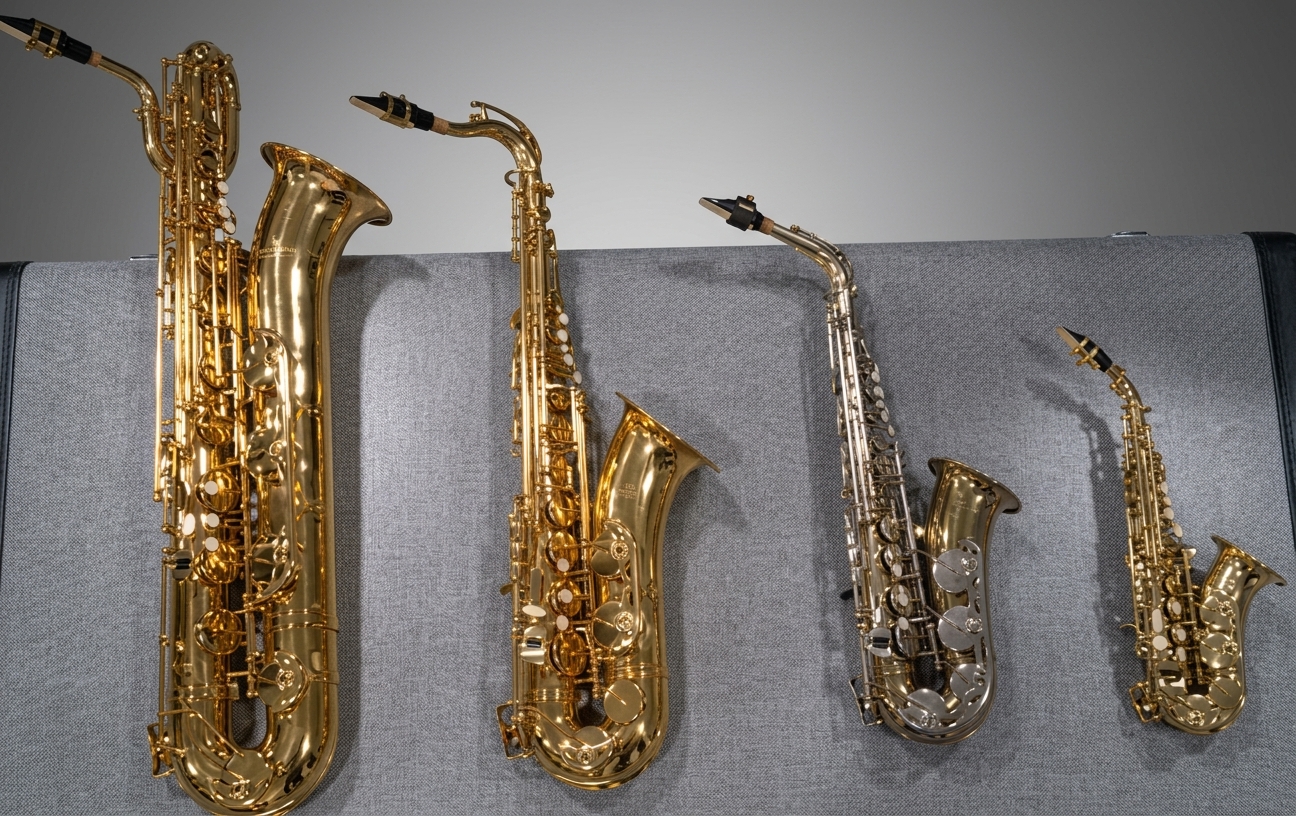
The sopranino sits near the top of this family. The smaller body produces a higher register, while larger saxophones create progressively lower sounds.
Henri SELMER Paris explains that Adolphe Sax originally conceived a much larger family, while today’s standard family has become centered around seven instruments. The E♭ sopranino remains the highest member of that established modern family.
Quick Sopranino Facts
| Feature | Sopranino Saxophone |
|---|---|
| Type | Single-reed woodwind |
| Typical key | E♭ |
| Family position | Highest traditional saxophone voice |
| Body style | Usually straight |
| Sound | Bright, focused and high |
| Compared with soprano | Higher pitched |
| Typical use | Contemporary music, ensembles, jazz and specialist performance |
| Skill level | Intermediate to advanced |
| Common material | Brass |
| Mouthpiece | Small sopranino-specific design |
| Typical construction | Compact conical body |
| Notable makers | Henri SELMER Paris, Yanagisawa and specialist makers |
What Key Is the Sopranino Saxophone In?
The modern sopranino saxophone is normally pitched in E♭.
That means it is a transposing instrument. The written notes a player reads do not sound at exactly the same concert pitch. Understanding this relationship is essential when a sopranino player performs with piano, guitar, orchestral instruments, or other concert-pitch instruments.
The original saxophone concept included instruments in several keys, including an F sopranino. However, the F sopranino remained a theoretical design rather than becoming a standard production instrument. The E♭ version became the established sopranino used today.
Yanagisawa’s current sopranino models, for example, are specified in E♭ and include a high-E key.
How Does a Sopranino Sound?
The sound is one of the instrument’s biggest attractions.
A saxofon sopranino produces a high, clear and concentrated tone. Compared with an alto saxophone, it can sound more penetrating because its register occupies a much higher part of the musical spectrum.
That does not mean it must sound harsh.
A skilled player can produce warmth, softness and expressive color. Henri SELMER Paris describes its E♭ sopranino as having an attractive timbre and a warm relationship to the sound character of the E♭ alto.
Main Tonal Characteristics
Players often choose the instrument for qualities such as:
- High pitch
- Strong projection
- Clear articulation
- Focused tone
- Quick response
- Bright upper register
- Distinctive ensemble color
- Ability to cut through dense textures
Its small size does not make it a novelty instrument. In the hands of an experienced musician, it can perform demanding musical roles.
What Is the Playing Range?
The exact range depends on the individual instrument and its keywork.
For example, the Henri SELMER Paris Super Action 80 Series II sopranino is specified with an E♭ key and an ambitus from low B♭ to high F♯.
Some instruments have different upper-key configurations. Yanagisawa’s SN-901, for example, includes a high-E key.
Why Does Range Matter?
A wider practical range gives the musician greater flexibility for:
- Contemporary repertoire
- Solo passages
- Saxophone ensemble arrangements
- Extended techniques
- Jazz arrangements
- Doubling parts
- Experimental music
Players should therefore check the exact key configuration before buying an instrument rather than assuming every sopranino has identical high-note capabilities.
How Big Is a Sopranino?
The sopranino is considerably smaller than an alto, tenor or baritone saxophone.
Its compact dimensions allow it to sit comfortably in a vertical position similar to a small clarinet. This straight configuration is common because the instrument does not require the large curves associated with bigger saxophones.
Henri SELMER Paris notes that the bow—the curved lower section found on many saxophones—is absent on straight soprano and sopranino models.
The small body also creates a different physical experience for the player.
The keys are tightly arranged, the mouthpiece is small, and subtle changes in embouchure can produce noticeable pitch changes.
How Difficult Is It to Play?
A sopranino is small, but it is not necessarily easy.
In fact, its compact size can make certain aspects of playing more demanding. The high register exposes changes in air pressure, embouchure and tongue position more clearly.
A beginner may find the instrument less forgiving than an alto saxophone.
Players Need Good Control Of:
- Air pressure
- Air speed
- Embouchure
- Tongue position
- Finger coordination
- Intonation
- Articulation
- Dynamic control
- Breath support
Henri SELMER Paris specifically describes the sopranino as delicate in both construction and playing approach and notes that its accuracy and precision require considerable dexterity.
For that reason, it usually makes more sense as a second or specialist saxophone rather than a first instrument for a complete beginner.
What Music Uses the Sopranino?
The instrument has a specialized but expanding role.
You may hear a saxofon sopranino in:
- Contemporary classical music
- Saxophone ensembles
- Experimental music
- Jazz
- Chamber music
- Concert bands
- Studio projects
- Film and theatrical music
- Avant-garde compositions
Its unusual pitch makes it valuable when a composer wants a saxophone color that sits above the standard soprano register.
Henri SELMER Paris notes that the E♭ sopranino has historically been less common but has gained use in jazz and contemporary music.
Why Composers Like It
A composer can use the instrument to create:
- A piercing upper line
- A contrasting color against lower saxophones
- A delicate high texture
- A dramatic solo voice
- A bright ensemble layer
- An unusual timbral effect
It can therefore add a color that an alto or tenor cannot easily reproduce.
Sopranino vs. Soprano Saxophone
The names sound similar, but the instruments are different.
| Feature | Sopranino | Soprano |
|---|---|---|
| Typical key | E♭ | B♭ |
| Relative pitch | Higher | Lower |
| Size | Smaller | Larger |
| Sound | Very high and focused | High but fuller |
| Commonness | Rare | Much more common |
| Learning difficulty | Demanding | Demanding |
| Typical role | Specialist | Jazz, classical, pop, ensemble |
| Beginner suitability | Low | Moderate |
| Physical format | Usually straight | Straight or curved |
The soprano is widely recognized because players such as John Coltrane, Sidney Bechet and other major musicians helped establish it in jazz and popular music.
The sopranino occupies a more specialized position.
Sopranino vs. Alto Saxophone
The alto saxophone is much more common and generally easier to find, learn and maintain.
An alto is also larger, which gives it a lower and broader sound. The sopranino, by contrast, produces a much higher register and has a more concentrated voice.
| Feature | Sopranino | Alto |
|---|---|---|
| Key | E♭ | E♭ |
| Size | Very small | Medium |
| Register | Very high | Mid-high |
| Sound | Bright and focused | Fuller and broader |
| Availability | Limited | Excellent |
| Beginner friendly | Usually no | Yes |
| Typical price | Often high | Wide range |
| Primary role | Specialist | General-purpose |
Both instruments are E♭ transposing saxophones, but their musical roles are very different.
The History of the Sopranino
The history of the saxofon sopranino begins with Adolphe Sax, the Belgian instrument maker who created the saxophone family in the nineteenth century.
Sax demonstrated his saxophone in Paris during the early 1840s and later patented the instrument in 1846. His concept was not a single saxophone but a complete family covering a wide range of pitches.
The original family was considerably broader than the modern lineup.
Sax envisioned instruments ranging from very small high-pitched saxophones to enormous low-register instruments. Not every proposed model entered regular production.
The E♭ sopranino survived as part of the established family.
The instrument’s development continued through later manufacturers. Henri SELMER Paris documents a long history of sopranino production, including early models and changes to keywork and construction.
The Sopranino and Adolphe Sax’s Original Vision
Adolphe Sax wanted the saxophone to combine qualities associated with woodwinds and brass instruments.
The instrument used a single reed, similar in principle to the clarinet, but employed a conical metal body. This combination gave the saxophone a distinctive tone and projection.
The Philharmonie de Paris describes Sax’s work on the complete saxophone family and highlights the importance of the instrument’s bore proportions and conical design in its acoustical behavior.
That design philosophy remains important today.
Even though modern manufacturing has changed dramatically, the basic acoustic concept remains recognizable.
Modern Sopranino Saxophone Design
Today’s instruments use carefully engineered keywork, pads, springs, tone holes and octave mechanisms.
The small physical scale leaves little room for mechanical errors.
Yanagisawa’s current sopranino design, for example, uses a brass body, an ebonite mouthpiece, waterproof pads, precision pivot screws and a specially engineered octave mechanism.
These details matter because small instruments can expose mechanical problems quickly.
A tiny leak that might be manageable on another saxophone can create serious response or intonation problems on a sopranino.
What Should You Look for When Buying One?
Buying a sopranino requires more care than buying a common student alto.
1. Intonation
Accurate pitch should be your first priority.
Play long tones across the register and compare notes with a reliable tuner. Do not judge an instrument only by how it feels on the easiest notes.
2. Keywork
Check that every key moves smoothly.
Listen for:
- Clicking
- Excessive mechanical noise
- Slow return
- Sticky pads
- Loose rods
- Uneven key pressure
3. Response
Test low notes and high notes separately.
A good instrument should respond predictably throughout its usable range.
4. Build Quality
Look closely at:
- Solder joints
- Tone-hole condition
- Key guards
- Posts
- Neck fit
- Pad seating
- Finish
5. Mouthpiece Compatibility
The mouthpiece has a major effect on response, tone and intonation. Make sure the instrument includes a suitable mouthpiece or budget for a quality replacement.
Mouthpieces, Reeds and Setup
The mouthpiece is particularly important on a small high-register saxophone.
A poorly matched mouthpiece can make the instrument feel unnecessarily difficult. A suitable design can improve response, articulation and tonal control.
Henri SELMER Paris offers a dedicated S80 sopranino mouthpiece and describes it as producing a warm, full sound. Its listed C* version has a 1.10 mm table opening and an 18 mm table length.
Reed Selection
Reeds should match the mouthpiece and player’s embouchure.
Do not assume that a harder reed automatically produces a better sound.
Instead, look for:
- Stable response
- Easy articulation
- Consistent pitch
- Comfortable resistance
- Clean high notes
- Controlled dynamics
Experiment gradually rather than changing several parts of the setup at once.
How to Maintain a Sopranino
Small saxophones require careful maintenance.
After playing:
- Remove moisture from the instrument.
- Swab the body according to the manufacturer’s instructions.
- Clean the mouthpiece.
- Inspect the pads.
- Check the neck and mouthpiece connection.
- Store the instrument in its case.
- Avoid leaving it in extreme temperatures.
- Have it professionally adjusted when necessary.
Regular maintenance helps protect response and intonation.
Yanagisawa specifically highlights sealed, waterproof pads and precision mechanical components in its sopranino construction, but even high-quality materials still require proper care.
Who Should Buy a Sopranino?
A sopranino can be an excellent choice for the right musician.
It is particularly suitable for:
- Experienced saxophonists
- Professional performers
- Contemporary music specialists
- Saxophone ensemble players
- Jazz musicians seeking unusual colors
- Composers and arrangers
- Recording musicians
- Advanced students with specialist guidance
It is less suitable as a first saxophone.
If you are learning saxophone for the first time, an alto generally offers a more accessible starting point because of its size, availability and established teaching resources.
Once a player develops reliable breath support, fingering control and embouchure technique, moving to a sopranino becomes more realistic.
Which Sopranino Brands Are Worth Considering?
The market is much smaller than the market for alto or tenor saxophones.
Two established professional manufacturers with documented current sopranino offerings are Henri SELMER Paris and Yanagisawa.
Henri SELMER Paris
The Henri SELMER Paris Super Action 80 Series II E♭ sopranino features a low B♭ to high F♯ range, leather pads with metal resonators and a dedicated S80 C* mouthpiece as standard equipment.
The company positions the model as a carefully manufactured professional instrument with a warm, colorful sound.
Yanagisawa
Yanagisawa’s current 900 series includes E♭ sopranino instruments. The company’s SN-901 is listed with a brass body, high-E key, ebonite mouthpiece and case.
Yanagisawa has also documented a long history of sopranino development, including earlier SN models.
Complete Saxofon Sopranino Comparison Table
| Category | Sopranino | Soprano | Alto | Tenor |
|---|---|---|---|---|
| Typical key | E♭ | B♭ | E♭ | B♭ |
| Relative pitch | Highest | High | Medium | Lower |
| Physical size | Smallest traditional | Small | Medium | Large |
| Typical body | Straight | Straight/curved | Curved | Curved |
| Tone | Bright, focused | Clear, expressive | Full, balanced | Powerful, warm |
| Availability | Limited | High | Very high | Very high |
| Beginner use | Rare | Occasional | Common | Common |
| Advanced use | Excellent | Excellent | Excellent | Excellent |
| Ensemble value | Specialist | High | High | High |
| Maintenance | Precise | Precise | Moderate | Moderate |
| Typical role | Specialty voice | Lead/high voice | General purpose | Mid-low voice |
Is a Sopranino Worth Buying?
For the right player, yes.
The value does not come from versatility in the same way an alto or tenor provides versatility. Instead, the instrument offers a very specific musical voice that few other saxophones can reproduce.
Before purchasing, ask yourself:
- Do I already play saxophone confidently?
- Do I need an unusually high saxophone voice?
- Will I perform contemporary or experimental music?
- Do I have access to a teacher experienced with the instrument?
- Can I afford professional maintenance?
- Have I tested the instrument personally?
If the answers are mostly yes, a sopranino can become a powerful addition to your saxophone collection.
Frequently Asked Questions About Saxofon Sopranino
What is a saxofon sopranino?
Answer: A saxofon sopranino is a small, high-pitched saxophone that normally comes in E♭. It sits above the soprano in the traditional saxophone family and is used mainly by advanced and specialist players.
Is the sopranino saxophone higher than the soprano?
Answer: Yes. The E♭ sopranino occupies a higher register than the standard B♭ soprano saxophone, making it one of the highest traditional voices in the saxophone family.
Is the sopranino difficult to play?
Answer: It can be challenging because its small dimensions and high register demand precise embouchure, breath control, fingering and intonation. Henri SELMER Paris describes it as a delicate instrument requiring considerable precision.
What key is a sopranino saxophone in?
Answer: Modern sopranino saxophones are typically in E♭. Historical saxophone designs included other proposed keys, but the E♭ model became the established sopranino.
What music uses the sopranino saxophone?
Answer: You can find it in contemporary classical music, saxophone ensembles, jazz, experimental music, concert bands and specialist performance. Its high register makes it useful when composers want an unusual upper voice.
Is a sopranino good for beginners?
Answer: Usually not. A beginner will generally find an alto saxophone easier to learn because it is more common and has a broad range of teaching materials. A sopranino makes more sense after developing solid saxophone fundamentals.
Final Thoughts
The saxofon sopranino is small in size but significant in musical character. Its high E♭ voice, focused tone and unusual range give experienced musicians an expressive option that standard soprano, alto and tenor saxophones cannot completely replace.
Its specialist nature is also its greatest strength. Contemporary composers, saxophone ensembles, jazz musicians and adventurous performers can use its distinctive register to add color, contrast and excitement to an arrangement.
If you are considering one, focus on intonation, response, keywork, mouthpiece quality and professional setup rather than choosing solely by appearance. A well-adjusted instrument from an established maker such as Henri SELMER Paris or Yanagisawa can give an experienced player a remarkably expressive high-register voice.
Author and Source Note
Editorial expertise: This article focuses on documented instrument specifications, saxophone history, acoustical design and manufacturer information. Product specifications can change, so buyers should verify the current model details directly with the manufacturer before purchasing.6