Pappedeckel Explained: Meaning, Uses and Benefits
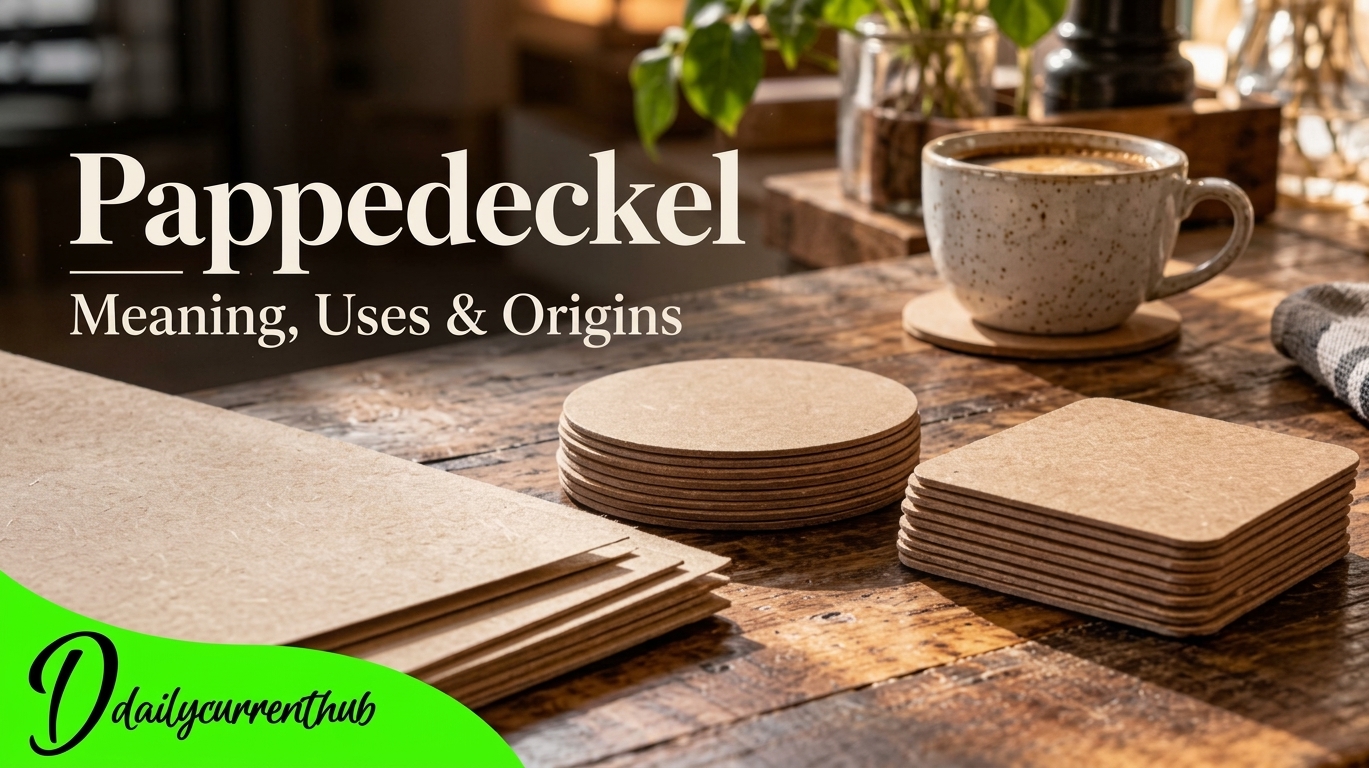
Pappedeckel is a German term associated with cardboard or a piece of stiff paper-based board. Its closest standard German forms are Pappdeckel and Pappendeckel, which German dictionaries define as a piece of cardboard. The precise English translation depends on the object and the sentence in which the word appears.
According to the German dictionary Duden, Pappdeckel means a rectangular piece of cardboard. Duden lists Pappendeckel as a related form with the same basic meaning. Source: Duden’s Pappdeckel entry.
The word should not automatically be interpreted as the name of a particular commercial product. It does not specify a standard thickness, material grade, coating, shape, or manufacturing method.
Depending on the context, suitable English translations may include:
- Cardboard
- A piece of cardboard
- A paperboard sheet
- A cardboard cover
- A cardboard lid, when the object actually closes a container
For example, a flat piece of cardboard used beneath an object is not necessarily a lid. Similarly, a rigid board used inside a book cover has a different practical role from a disposable container closure.
The main point is simple: identify the object before choosing the translation.
2. What Does Pappedeckel Mean in English?
There is no single English expression that fits every possible use of the term. The safest translation usually describes the material or the physical object rather than relying on a literal translation of the word’s individual parts.
The German word Pappe refers to firm, relatively stiff paper-based material. Deckel commonly means a lid or cover. However, the established meaning of a compound word does not always match the literal meaning of its components. Sources: Duden’s entries for Pappe and Deckel.
Use this guide when translating the term:
| Context | Suitable English wording | Why it fits |
|---|---|---|
| General conversation | Cardboard | Describes the material |
| A flat piece of board | Piece of cardboard | Describes an individual object |
| A packaging component | Cardboard insert or board | Depends on the component’s role |
| A container closure | Cardboard lid | Appropriate when it actually closes a container |
| A rigid book component | Bookbinding board or cover board | Describes its use in book construction |
| A school or craft project | Cardboard sheet | Clear and familiar wording |
A translator should also consider the sentence’s tone. Everyday German, technical documentation, product descriptions, and regional speech may use different expressions for similar materials.
3. How Did the Word Develop?
German often creates compound nouns by joining shorter words. This process allows speakers to describe objects by combining familiar concepts.
The related word Pappdeckel illustrates this pattern. Its elements connect cardboard with the idea of a cover or lid, yet the dictionary meaning extends to a piece of cardboard more generally.
The material itself has a long history in printing, packaging, bookbinding, and everyday household use. Paper-based boards became useful wherever ordinary paper needed more stiffness or thickness.
Today, cardboard and paperboard serve a wide range of purposes, from protective packaging to rigid book covers and craft materials. The exact product depends on how the fibers are processed, how the layers are formed, and whether the material receives additional treatment.
It is important not to confuse the word’s linguistic history with the history of one particular product. Pappedeckel does not identify a single invention, brand, or standardized packaging design.
4. What Is the Difference Between Pappedeckel, Pappdeckel, and Pappendeckel?
Spelling is an important part of understanding this keyword.
Duden recognizes Pappdeckel and Pappendeckel as related German forms. Both refer to a piece of cardboard. The spelling Pappedeckel also appears in online searches and some regional or informal contexts, but it should not automatically replace the established forms in formal German writing.
| Term | General interpretation | Practical guidance |
|---|---|---|
| Pappedeckel | Search term associated with cardboard terminology | Interpret according to the surrounding context |
| Pappdeckel | Standard dictionary form for a piece of cardboard | Suitable when using the established spelling |
| Pappendeckel | Related standard form for a piece of cardboard | Also recognized by German dictionaries |
| Pappe | Cardboard or stiff paper-based material | Often describes the material itself |
| Karton | Cardboard, paperboard, or a cardboard container, depending on context | Check the sentence for the intended meaning |
| Deckel | Lid or cover | Usually describes a covering or closure rather than the board material |
Which spelling should you use?
If you are writing formal German, consult a recognized German dictionary and choose the form appropriate to your sentence. If you are researching the exact keyword Pappedeckel, it is useful to understand the related forms so that your search covers the intended subject.
5. What Materials Are Used to Make Cardboard?
Cardboard and paperboard are not all made to the same specification. Manufacturers select fibers, thicknesses, layer structures, and surface treatments according to the product’s intended use.
Recycled Paper Fibers
Manufacturers can use recovered paper and cardboard as a source of fiber. Recycling reduces the need for virgin fiber in suitable products, although the final quality depends on the condition and type of recovered material.
The German Environment Agency reports that recovered paper supplied approximately 84% of the paper industry’s fiber input in Germany in 2024. This figure describes the industry-wide use of recovered paper, not the recycled content of every individual cardboard product. Source: German Environment Agency.
Virgin Paper Fibers
Virgin fibers come from newly processed plant-based raw materials. Manufacturers may use them when a product requires particular strength, appearance, cleanliness, or consistency.
Their suitability depends on the product specification and the intended conditions of use.
Multiple-Layer Board
Some boards contain multiple paper layers joined together to achieve greater thickness or stiffness. The layers and bonding methods influence the material’s performance.
Coatings and Surface Treatments
A board may receive a coating, printed surface, adhesive, or moisture-resistant treatment. These additions can change its appearance, performance, and recycling requirements.
A cardboard item that looks simple may therefore contain more than plain paper fibers. Always check the product specification if moisture resistance, food contact, or recyclability matters.
6. How Is Paperboard Manufactured?
Manufacturing methods vary by board grade, but the general process follows several stages.
<text>Step 1: Fiber preparation.</text>
Manufacturers prepare paper fibers from virgin pulp, recovered paper, or a suitable combination. They remove contaminants and prepare the material for forming.
<text>Step 2: Sheet formation.</text>
The fibers mix with water and form a wet sheet. Equipment distributes the fibers across a forming surface to create a consistent layer.
<text>Step 3: Pressing and drying.</text>
The sheet passes through processes that remove water and consolidate the fibers. Drying helps the material reach its required moisture level.
<text>Step 4: Layering and finishing.</text>
Depending on the grade, manufacturers may combine layers, smooth the surface, add coatings, or apply other finishing treatments.
<text>Step 5: Cutting and converting.</text>
The finished board is cut into sheets, discs, panels, or other shapes. Converters may print, fold, laminate, or otherwise prepare it for a particular application.
These steps describe a general production pathway, not a single recipe for every paperboard product. Different grades use different equipment and processing methods.
7. What Are the Common Uses of Pappedeckel?
Because the term is associated with cardboard, its practical applications depend on the actual object being described.
Packaging and Shipping
Cardboard components can protect products, separate items inside boxes, cover openings, and provide a stable surface for handling. Packaging designers select the grade and thickness according to the product’s weight, shape, and transport conditions.
Bookbinding
Rigid board provides structure for many hardback book covers. Bookbinders may cover the board with paper, cloth, or another finishing material to create the finished appearance.
Arts and Crafts
Cardboard is useful for school projects, models, signs, templates, decorative panels, and handmade organizers. It is relatively easy to cut and shape with suitable tools.
Household Organization
Stiff cardboard can serve as drawer dividers, backing panels, separators, and temporary organizers. The best material depends on the expected weight and whether the object may come into contact with moisture.
Product Presentation
Printed paperboard can support branding and presentation in retail packaging. Surface finish, color quality, and stiffness can influence the final appearance.
These are uses of cardboard and paperboard products in general. They do not mean every object described by the German term has all these properties.
8. Pappedeckel in Packaging and Product Protection
Packaging is one of the clearest examples of why the material’s specification matters.
A piece of cardboard may separate products, reduce surface scratching, cover an opening, or help maintain the shape of a package. However, its suitability depends on the type of product and the conditions it must withstand.
Before selecting a board for packaging, consider these factors:
- Weight: Heavy products may require stronger or thicker material.
- Shape: Flat, fragile, or irregular objects may need different support.
- Moisture: Ordinary paperboard can soften when wet.
- Surface protection: Smooth finishes may help reduce scratching.
- Printing: Coatings and surface quality can affect print results.
- Storage: Humidity and stacking pressure can change board performance.
- End of life: Adhesives, coatings, and contamination can affect recycling.
Is a Cardboard Lid the Same as a Paperboard Sheet?
No. A sheet is a material form, while a lid is a component designed to cover or close something. A lid may be made from paperboard, but it must have the correct dimensions, shape, stiffness, and fit for its intended container.
For food or drink packaging, do not assume that a cardboard product is safe for direct food contact simply because it is paper-based. Check the manufacturer’s specifications and applicable food-contact requirements.
9. How Does It Compare With Other Materials?
Choosing between cardboard, paper, plastic, and wood depends on the job. Each material has different strengths and limitations.
| Feature | Cardboard or paperboard | Ordinary paper | Plastic sheet | Thin wood panel |
|---|---|---|---|---|
| Stiffness | Varies from flexible to rigid | Usually low | Depends on polymer and thickness | Generally rigid |
| Weight | Usually low | Very low | Varies | Often higher than paperboard |
| Cutting and shaping | Often easy with suitable tools | Very easy | Depends on type | Requires suitable tools |
| Moisture resistance | Often limited unless treated | Usually limited | Often good, depending on polymer | Varies by wood and finish |
| Printing | Commonly suitable | Commonly suitable | Depends on surface treatment | Requires suitable preparation |
| Reuse potential | Depends on condition and design | Depends on condition | Depends on durability | Can be reused when intact |
| Recycling | Often possible if clean and accepted locally | Often possible if clean and accepted locally | Depends on polymer and local facilities | Depends on local collection systems |
| Typical applications | Boxes, covers, inserts, crafts | Printing, writing, wrapping | Containers, protective sheets, specialized packaging | Panels, models, furniture components |
This comparison is general. Actual performance depends on the material grade, thickness, design, and local recycling options.
10. Is Pappedeckel Environmentally Friendly?
Paper-based products can support recycling and material recovery, but their environmental impact depends on more than the raw material.
The German Environment Agency explains that using recovered paper can reduce the consumption of virgin resources and lower certain resource requirements per tonne of paper. It also notes that contamination from printing inks, adhesives, and paper additives can complicate recycling. Source: German Environment Agency’s recovered-paper data.
Factors That Influence Sustainability
Recycled content: Products made with recovered fibers can reduce demand for virgin fibers, subject to product requirements.
Product durability: A board that serves its purpose without excessive material use may avoid unnecessary waste.
Coatings and adhesives: Some finishes make sorting and recycling more difficult.
Transport and production: Manufacturing energy, water use, and transportation contribute to a product’s overall environmental footprint.
Waste collection: A theoretically recyclable item may not be accepted in every local recycling system.
The European Commission’s packaging framework addresses packaging design, waste prevention, collection, and recycling. These requirements reinforce the importance of considering a package’s full life cycle rather than judging it only by appearance. Source: European Commission packaging-waste policy.
How Can You Dispose of Cardboard Responsibly?
- Keep cardboard clean and dry where practical.
- Remove non-paper components if local instructions require it.
- Separate heavily contaminated items according to local waste guidance.
- Check whether coated or laminated products are accepted.
- Reuse suitable pieces before recycling them.
Do not assume that every paper-based product is compostable or recyclable in every facility.
11. How Should You Choose the Right Cardboard?
The best board depends on the job it needs to perform. A lightweight craft project does not need the same material as a heavy-duty shipping insert.
Use the following checklist before buying:
| Selection factor | What to check | Why it matters |
|---|---|---|
| Thickness | The specified board thickness | Influences stiffness and fit |
| Stiffness | Whether the board bends under the expected load | Helps the product retain its shape |
| Surface | Smooth, textured, coated, or uncoated | Affects printing and appearance |
| Moisture exposure | Dry indoor use or humid conditions | Helps determine whether a special treatment is needed |
| Dimensions | Sheet size, diameter, or cut shape | Reduces waste and fitting problems |
| Recycled content | Supplier’s declared percentage, if relevant | Helps assess material sourcing |
| Food-contact suitability | Manufacturer’s compliance information | Important for products that touch food |
| End-of-life options | Local recycling acceptance | Helps plan disposal |
| Cost | Price per usable item or sheet | Supports a fair comparison between products |
Ask the supplier for a technical data sheet when the board needs to meet a specific requirement. For a simple craft, visual inspection and a small test may be enough. For packaging that protects valuable or fragile goods, test the material under realistic conditions.
12. Common Mistakes to Avoid
A few avoidable errors can cause confusion when researching or using cardboard products.
- Assuming the word always means a lid: The established dictionary meaning of Pappdeckel is broader than a container closure.
- Treating every cardboard grade as identical: Thickness, fiber structure, coatings, and strength vary.
- Assuming paper-based means waterproof: Ordinary cardboard may weaken when exposed to moisture.
- Assuming all products are recyclable everywhere: Local collection rules and product composition matter.
- Ignoring coatings and adhesives: These may affect disposal and recycling.
- Using an unsuitable board for heavy loads: Material selection should match the product’s intended use.
- Using informal spelling in formal translation without checking: Consult a dictionary when spelling accuracy matters.
The most reliable approach is to separate the meaning of the word from the properties of the physical material.
13. Storage, Handling, and Reuse Tips
Good handling helps cardboard retain its shape and remain useful for longer.
- Store sheets on a flat surface when possible.
- Keep the material away from leaks and excessive humidity.
- Avoid placing heavy objects on unsupported or thin sheets.
- Protect finished surfaces from dirt and abrasion.
- Reuse clean offcuts for templates, dividers, or craft projects.
- Keep food-contact materials separate from items with unknown coatings or contamination.
- Follow local guidance when the material is no longer suitable for reuse.
For commercial storage, follow the supplier’s recommendations for temperature, humidity, stacking, and handling. These details matter most when dimensional stability and consistent product quality are important.
14. Frequently Asked Questions About Pappedeckel
1. What does Pappedeckel mean in English?
It is associated with German cardboard terminology. Depending on context, an appropriate translation may be cardboard, a piece of cardboard, a paperboard sheet, or a cardboard cover.
2. Is Pappedeckel the standard German spelling?
The recognized dictionary forms include Pappdeckel and Pappendeckel. Pappedeckel appears as a search term and in some regional or informal contexts, so formal writing should use the form appropriate to the intended meaning.
3. Is Pappedeckel always a cardboard lid?
No. The closely related standard form Pappdeckel is defined by Duden as a piece of cardboard. The term does not always describe a lid designed to close a container.
4. What is the difference between cardboard and paperboard?
The terms overlap in everyday and commercial use. Their exact definitions can vary by country and industry, so check the manufacturer’s material specification when thickness, stiffness, or performance matters.
5. Can cardboard products be recycled?
Many clean paperboard and cardboard products can enter paper-recycling systems, but acceptance depends on local rules and the product’s coatings, adhesives, and contamination. Check your local collection guidance.
6. How do I choose the right cardboard for a project?
Start with the intended use, required stiffness, dimensions, moisture exposure, and surface finish. For packaging or other applications with strict performance requirements, request the supplier’s specifications and test the material before use.
Conclusion
Pappedeckel is a useful keyword for exploring German cardboard terminology, but its meaning becomes clearer when you distinguish the searched spelling from the established forms Pappdeckel and Pappendeckel. The related words generally refer to cardboard or a piece of stiff paper-based board, while the most natural English translation depends on the object and its purpose.
Cardboard and paperboard serve many practical roles in packaging, bookbinding, crafts, product protection, and household organization. Choosing the right product requires attention to thickness, stiffness, coatings, moisture resistance, and end-of-life options.
If you are translating a German text, start with a recognized dictionary and examine the surrounding sentence. If you are selecting a physical material, check its technical specifications and local recycling requirements. Those simple steps will help you make clearer, more informed decisions..